AI systems are evolving fast. You’ve probably heard these terms everywhere:
- AI agent
- LLM agent
- Workflow orchestrator
- Agentic systems
- Multi-agent architecture
But here’s the real question developers and CTOs are asking:
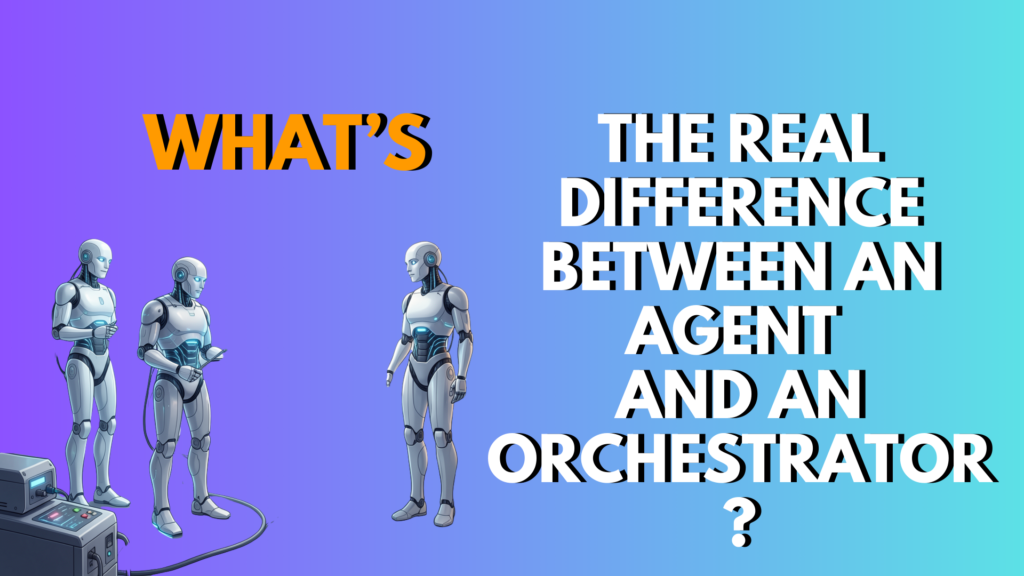
What’s the real difference between an agent and an orchestrator?
They sound similar. They sometimes work together. But technically, they are not the same thing.
If you’re building AI systems, SaaS tools, autonomous workflows, or multi-model pipelines, understanding this distinction is critical.
In this complete, beginner-friendly yet technical guide, we’ll break everything down:
- Clear definitions
- Architecture comparison
- Real-world examples
- Step-by-step implementation guide
- Common mistakes
- Code examples
- Best practices
- Troubleshooting
- SEO-ready internal structure for WordPress
Let’s dive in.
Table of Contents
- What Is an AI Agent?
- What Is an Orchestrator?
- The Real Difference Between an Agent and an Orchestrator
- Agent vs Orchestrator Comparison Table
- How Agents and Orchestrators Work Together
- Step-by-Step: Building an Agent
- Step-by-Step: Building an Orchestrator
- Code Examples (Simple Python Architecture)
- Common Mistakes Developers Make
- Best Practices for Production Systems
- When to Use an Agent vs an Orchestrator
- Alternatives and Hybrid Architectures
- Conclusion
- FAQ – People Also Ask
What Is an AI Agent?
An AI agent is a system that:
- Perceives input
- Makes decisions
- Takes actions
- Pursues goals
- Adapts based on feedback
An agent has agency. It operates toward objectives.
Key Characteristics of an Agent
- Goal-oriented behavior
- Decision-making autonomy
- Tool usage capability
- Memory (short-term or long-term)
- Ability to react dynamically
Example of an AI Agent
A research agent that:
- Receives a user query
- Searches the web
- Reads documents
- Summarizes findings
- Refines output
It decides what to do next based on context.
What Is an Orchestrator?
An orchestrator is a system that:
- Manages workflows
- Coordinates multiple components
- Routes tasks between services
- Controls execution order
An orchestrator does not necessarily make decisions autonomously. It enforces structure.
Key Characteristics of an Orchestrator
- Workflow management
- Task sequencing
- State tracking
- Conditional routing
- System coordination
Example of an Orchestrator
A backend service that:
- Receives a user request
- Calls a transcription API
- Sends result to summarization model
- Stores output in database
- Returns final result
It controls flow, but it does not “think.”
The Real Difference Between an Agent and an Orchestrator
Here’s the core difference:
An agent decides what to do.
An orchestrator decides when and how components execute.
Agents focus on intelligence.
Orchestrators focus on structure and coordination.
Agent vs Orchestrator Comparison Table
| Feature | Agent | Orchestrator |
|---|---|---|
| Makes independent decisions | Yes | Usually No |
| Goal-driven behavior | Yes | No |
| Manages workflows | Sometimes | Yes |
| Coordinates multiple services | Optional | Yes |
| Learns/adapts | Often | Rarely |
| Controls task order | Dynamically | Predefined logic |
| Example | AI research bot | Workflow engine |
This distinction matters deeply in production architecture.
How Agents and Orchestrators Work Together
In modern AI systems, you often use both.
Typical Architecture
User
  ↓
Orchestrator
  ↓
Agent
  ↓
Tools / APIs / Models
The orchestrator:
- Handles authentication
- Routes requests
- Logs activity
- Manages system state
The agent:
- Decides which tool to call
- Determines reasoning steps
- Chooses strategy
This separation improves scalability.
Step-by-Step: Building an Agent (Beginner Guide)
Let’s build a simple AI agent conceptually.
Step 1: Define the Goal
Example: “Answer technical questions using web research.”
Step 2: Provide Tools
- Web search API
- Summarizer
- Calculator
- Database
Step 3: Implement Decision Logic
The agent must:
- Analyze the task
- Decide which tool to use
- Interpret results
Step 4: Add Memory
Memory types:
- Short-term conversation memory
- Long-term knowledge base
Step 5: Add Feedback Loop
Evaluate:
- Did it answer correctly?
- Did it use correct tools?
That’s an agent.
Step-by-Step: Building an Orchestrator
Now let’s build a simple orchestrator.
Step 1: Define Workflow
Example:
- Upload file
- Transcribe
- Summarize
- Store
Step 2: Define Execution Order
Hard-coded or conditional flow.
Step 3: Implement State Management
Track:
- Job ID
- Status
- Errors
Step 4: Add Error Handling
Retry failed tasks.
Step 5: Add Monitoring
Log:
- Execution time
- Failures
- Resource usage
That’s orchestration.
Code Example: Agent vs Orchestrator (Simplified Python)
Example Agent
class Agent:
    def __init__(self, tools):
        self.tools = tools

    def decide(self, task):
        if "calculate" in task:
            return self.tools["calculator"](task)
        elif "search" in task:
            return self.tools["search"](task)
        else:
            return "Unknown task"
The agent chooses dynamically.
Example Orchestrator
class Orchestrator:
    def process(self, file):
        transcript = transcribe(file)
        summary = summarize(transcript)
        store(summary)
        return summary
The orchestrator follows a defined flow.
Common Mistakes Developers Make
Mistake 1: Calling Everything an Agent
Many “agents” are just orchestrated workflows.
Mistake 2: Giving Orchestrators Too Much Intelligence
Workflow engines shouldn’t handle reasoning complexity.
Mistake 3: Ignoring Separation of Concerns
Mixing orchestration and decision logic leads to messy architecture.
Mistake 4: Overengineering Agents
Not every system needs autonomy.
Best Practices for Production Systems
1. Separate Responsibilities
- Agent = reasoning
- Orchestrator = execution management
2. Keep Orchestrators Deterministic
Predictable flow improves reliability.
3. Log Agent Decisions
For debugging and audit trails.
4. Implement Guardrails
Limit agent actions in production.
5. Use Monitoring Tools
Track both workflow and reasoning errors.
When Should You Use an Agent?
Use an agent when:
- Tasks require dynamic reasoning
- Tool selection varies
- User intent changes frequently
- Environment is unpredictable
Example: AI research assistant.
When Should You Use an Orchestrator?
Use an orchestrator when:
- Workflow is predictable
- Tasks are sequential
- Compliance matters
- Repeatability is critical
Example: SaaS backend pipeline.
Alternatives and Hybrid Architectures
Modern AI systems often use hybrid designs:
- Multi-agent systems
- Agent controlled by orchestrator
- Event-driven orchestration
- Human-in-the-loop supervision
Hybrid systems provide flexibility and control.
For deeper technical architecture breakdowns, explore:
- AI autonomy explained → darekdari.com/autonomous-ai-explained
- AI workflow architecture guide → darekdari.com/ai-workflow-design
- AI system monitoring strategies → darekdari.com/ai-monitoring-guide
(Use these as internal WordPress links.)
Conclusion: What’s the Real Difference Between an Agent and an Orchestrator?
The difference is simple but powerful:
- An agent thinks and decides.
- An orchestrator manages and coordinates.
Agents focus on intelligence.
Orchestrators focus on structure.
If you mix them, you get complexity.
If you separate them, you get scalable architecture.
Understanding this difference is essential for modern AI system design.
For more advanced AI architecture breakdowns and production-ready guides, visit darekdari.com and strengthen your AI engineering skills.
FAQ – People Also Ask
1. Is an orchestrator the same as an AI agent?
No. An orchestrator manages workflows, while an agent makes decisions.
2. Can an orchestrator contain agents?
Yes. Orchestrators often manage multiple agents.
3. Do AI agents always use LLMs?
Not necessarily. Agents can use rule-based or ML systems.
4. What is a multi-agent system?
A system where multiple agents interact or collaborate.
5. Is Kubernetes an orchestrator?
Yes, but for containers, not AI reasoning.
6. Should I build an agent or workflow system?
Depends on whether you need autonomy or structured task execution.
7. Can an agent replace an orchestrator?
Usually no. Large systems require orchestration.
8. Are agents reliable in production?
Only with guardrails, monitoring, and fallback systems.
9. What is agentic architecture?
An architecture built around autonomous agents.
10. Why is the agent vs orchestrator distinction important?
It ensures clean system design and scalability.
If you’re building AI systems seriously, understanding architecture fundamentals like this is non-negotiable. Dive deeper at darekdari.com and build smarter AI infrastructure today.
Learn more



0 Comments